
Vadzo Imaging explains why pixel size vs resolution is the defining factor in low-light camera performance, highlighting how increasing resolution reduces pixel size and impacts image quality. Through a portfolio of four MIPI camera modules, Vadzo demonstrates how selecting the right pixel size for real-world lighting conditions enables more reliable imaging across embedded vision, surveillance, and industrial applications.
FORT WORTH, TX / ACCESS Newswire / April 24, 2026 / Vadzo Imaging, a provider of embedded vision cameras, addresses one of the most misunderstood decisions in camera system design: the relationship between pixel size vs resolution and why these two specifications often work against each other in low-light imaging. In practice, engineers and system integrators find that higher resolution alone does not solve performance challenges in dim or dark environments. Pixel size and resolution must be evaluated together, and in many real-world deployments, larger pixels deliver better results than higher megapixel counts.
Vadzo's response to this engineering challenge is a portfolio of four MIPI camera modules built around Sony sensors with distinct pixel size and resolution tradeoffs: the Bolt-2020MRS NIR Monochrome 20MP MIPI Camera, the Bolt-258CRA 4K PDAF MIPI Camera, and the Bolt-900MGS Monochrome Global Shutter IMX900 MIPI Camera. Each camera is purpose-built for embedded vision deployments where resolution definition alone is not sufficient and lighting conditions cannot be controlled.
Why Pixel Size Matters More Than Resolution in Low-Light Performance
The relationship between pixel size vs resolution appears simple on paper, but in practice it defines a critical engineering tradeoff. Resolution measures the total number of pixels within a sensor, while pixel size (in micrometres, µm) determines how much light each photosite can capture.
On a fixed sensor size, increasing resolution reduces pixel size. Smaller pixels collect fewer photons per exposure, resulting in lower signal-to-noise ratio in low-light conditions. Larger pixels capture more light, producing cleaner images under the same lighting environment.
This is why Vadzo's embedded camera lineup is designed around a range of pixel sizes rather than simply maximizing resolution ensuring optimal performance across real-world low-light imaging scenarios.
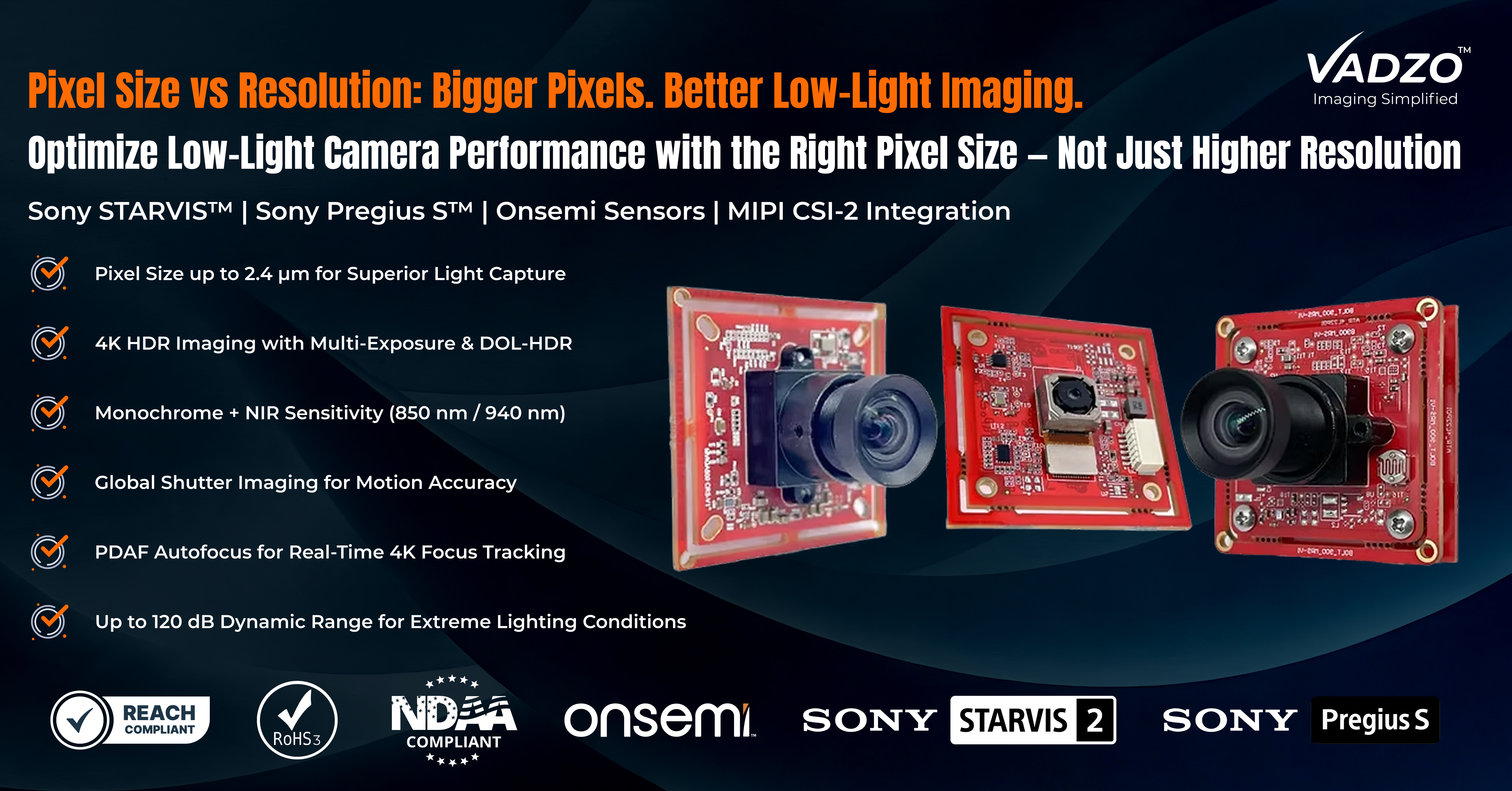
Bolt-2020MRS: 20MP NIR Monochrome MIPI Camera | High-Resolution Low-Light Imaging
The Bolt-2020MRS is a 20MP NIR monochrome MIPI camera built on the onsemi AR2020 sensor, delivering 4656 × 4176 resolution with a 2.4 µm pixel. In a monochrome configuration, the Bayer filter is removed, allowing each pixel to capture light directly and improving sensitivity compared to color sensors. Enhanced NIR response extends performance beyond visible light, making it suitable for document scanning, aerial inspection, and industrial metrology in low-light or IR-illuminated environments. Module-level drivers are available for Raspberry Pi, NVIDIA Jetson, and NXP i.MX8M Plus platforms.
Key specs: 20MP (4656x4176) | onsemi AR2020 | 2.4 µm Pixel | 1 inch Format | MIPI CSI-2 | Rolling Shutter | NIR Monochrome | -30°C to 70°C
Bolt-258CRA: 4K PDAF MIPI Camera | High-Speed Precision Imaging
The Bolt-258CRA is a 4K PDAF MIPI camera built on the Sony IMX258 sensor, delivering 13MP at 4208 × 3120 with phase detection autofocus integrated at the pixel level. PDAF enables fast and accurate focus tracking by measuring defocus direction in real time, outperforming contrast-based methods in dynamic scenes. This makes the camera well suited for robotics, drone imaging, and medical vision systems requiring continuous autofocus with minimal latency. Module-level drivers are available for Raspberry Pi, NVIDIA Jetson, and NXP i.MX8M Plus platforms.
Key specs: 13MP (4208x3120) | Sony IMX258 | 1.12 µm Pixel | 1/3.06 inch Format | MIPI CSI-2 | Rolling Shutter | Phase Detection Autofocus (PDAF) | -30°C to 70°C
Bolt-900MGS: IMX900 Monochrome Global Shutter MIPI Camera | Motion-Accurate Imaging
The IMX900 monochrome global shutter MIPI camera represents the most specialized pixel size and resolution tradeoff in the Vadzo MIPI lineup. Built on the Sony Pregius S IMX900 sensor, the Bolt-900MGS delivers 3.2MP imaging with a 2.25 µm BSI pixel, enabling distortion-free capture in motion-critical applications. Its global shutter eliminates rolling distortion, while high GSE and Quad HDR up to 120 dB ensure reliable performance in strobe-lit and IR-illuminated environments, with optimized NIR response at 850 nm and 940 nm.
Key specs: 3.2MP (2064x1552) | Sony IMX900 Pregius S | 2.25 µm BSI Pixel | 1/3.1 inch Format | MIPI CSI-2 | Global Shutter | Quad HDR (120 dB) | NIR Monochrome | -30°C to 70°C
Pixel Size vs Resolution Across Embedded Vision Applications
IR-Illuminated Access and Industrial Inspection - Bolt-900MGS: For environments where infrared illumination is the primary light source and subject motion must not introduce blur, the IMX900 global shutter monochrome camera (Bolt-900MGS) is the correct choice. Built on Sony Pregius S technology, it ensures distortion-free capture with high sensitivity in NIR-driven imaging setups.
High-Resolution Document and Aerial Imaging - Bolt-2020MRS: When the imaging task requires maximum spatial detail across a large scene and NIR sensitivity is critical, the 20MP monochrome MIPI camera based on AR2020 (Bolt-2020MRS) delivers fine feature resolution that exceeds typical color sensor performance at comparable pixel sizes.
4K Autofocus Vision Systems - Bolt-258CRA: For embedded deployments requiring both high resolution and adaptive focus, the AR1335 13MP autofocus MiPi camera module (Bolt-258CRA) combines PDAF-based focus tracking with stable 4K output, enabling accurate imaging across dynamic subject distances.
Vadzo OEM Support for System Integrators and Embedded Vision Developers
All four MIPI camera modules are supported with platform-specific drivers validated for Raspberry Pi, NVIDIA Jetson, and NXP i.MX8M Plus platforms, enabling integration through standard V4L2 and GStreamer pipelines on Linux-based systems. As MIPI integration is platform-dependent, there is no cross-platform SDK; however, Vadzo provides the VISPA NXT SDK for programmatic control of ISP parameters, streaming, GPIO, and firmware at the application level. Evaluation kits are available and full OEM customization includes board redesign, firmware development, lens and filter integration, and IP-rated enclosure design, with volume pricing and engineering support available on request.
"Engineers often assume higher megapixel counts will solve low-light challenges. In reality, increasing resolution on the same sensor reduces pixel size, limiting light capture and increasing noise. The right answer is rarely the highest resolution, it's selecting the right pixel size for the lighting conditions you cannot control." - Alwin Vincent, Product Manager, Vadzo Imaging.
FAQ
What is the practical difference between pixel size vs resolution in camera selection?
The pixel size vs resolution relationship defines overall image quality. Resolution describes the total number of pixels in a sensor, while pixel size defines how much light each pixel can capture. In a fixed sensor format, increasing resolution reduces pixel size. Smaller pixels collect less light, which lowers signal-to-noise ratio in low-light conditions. Larger pixels capture more photons and produce cleaner output, making them critical in low light camera applications and embedded vision camera systems.
Which camera is the best low light camera for IR-illuminated environments?
The IMX900 monochrome global shutter MIPI camera is purpose-built for IR-illuminated environments. Built on the Sony Pregius S sensor, it delivers strong NIR sensitivity and up to 120 dB HDR performance. This low light MIPI camera ensures distortion-free imaging with global shutter accuracy, making it ideal for industrial inspection, robotics, and IR-based surveillance systems.
Does higher resolution always mean better image quality?
No. Higher resolution does not always improve image quality, especially in low-light conditions. On the same sensor size, higher resolution results in smaller pixels and reduced light capture. For low light embedded camera applications, a lower resolution camera with larger pixels will often outperform a high resolution camera with smaller pixels in the same lighting conditions.
Can Vadzo customize these cameras for specific OEM form factors?
Yes. Vadzo supports full OEM customization across its MIPI camera modules and embedded vision camera platforms, including board redesign, firmware development, IR/NIR LED integration, lens holder modifications, and IP-rated enclosure design. These OEM camera solutions are tailored for robotics, industrial automation, and edge AI deployments.
Availability
All four camera are available for OEM evaluation. The Bolt-2020MRS, the Bolt-258CRA, and the Bolt-900MGS ship within standard lead times. Evaluation kits, technical documentation and integration support are available directly from Vadzo Imaging For inquiries contact the Vadzo sales team at support vadzoimaging.com.
About Vadzo Imaging
Vadzo Imaging develops high-performance embedded and machine vision camera for OEMs and system integrators building next-generation intelligent systems. The company delivers imaging platforms across USB, MIPI, GigE, Wi-Fi and SerDes interfaces supporting applications in industrial automation, robotics, smart surveillance, smart city infrastructure and edge AI. Beyond hardware Vadzo provides end-to-end imaging expertise including sensor integration ISP tuning firmware development and OEM customization services that accelerate development and deployment at scale.
Media Contact
Alwin Vincent
Vadzo Imaging
Email: alwin@vadzoimaging.com
LinkedIn: Vadzo Imaging
YouTube: Vadzo Imaging
X: Vadzo Imaging
SOURCE: Vadzo Imaging
View the original press release on ACCESS Newswire